
Story Prompt Generator
Beat the blank page with a story prompt built from five parts: a genre, a character with a hook, a vivid setting, a conflict that forces a choice and — if you dare — a twist or a writing constraint. Lock any part you like and reroll the rest, set a timer for a sprint, or generate a list of prompts for a class or a month-long challenge.
- Free to use
- No sign-up
- Runs in your browser
Story prompt generator
Creative Writing Prompt Pack
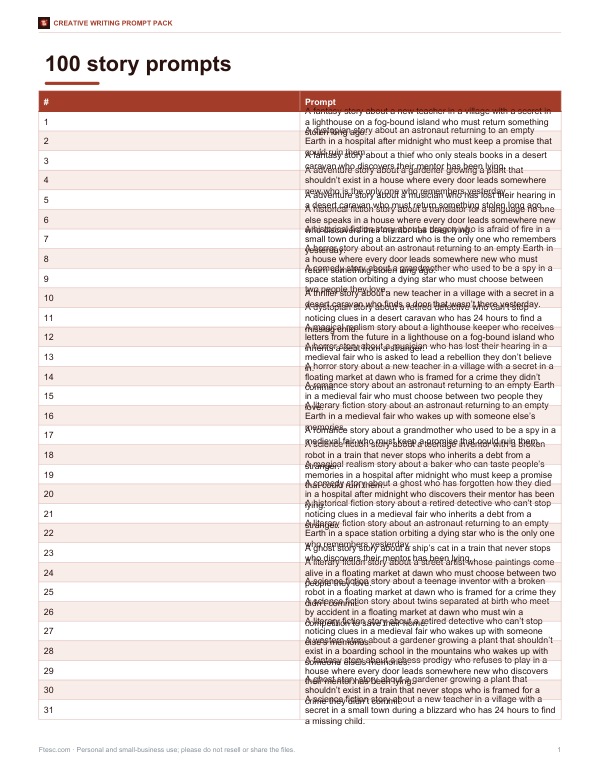
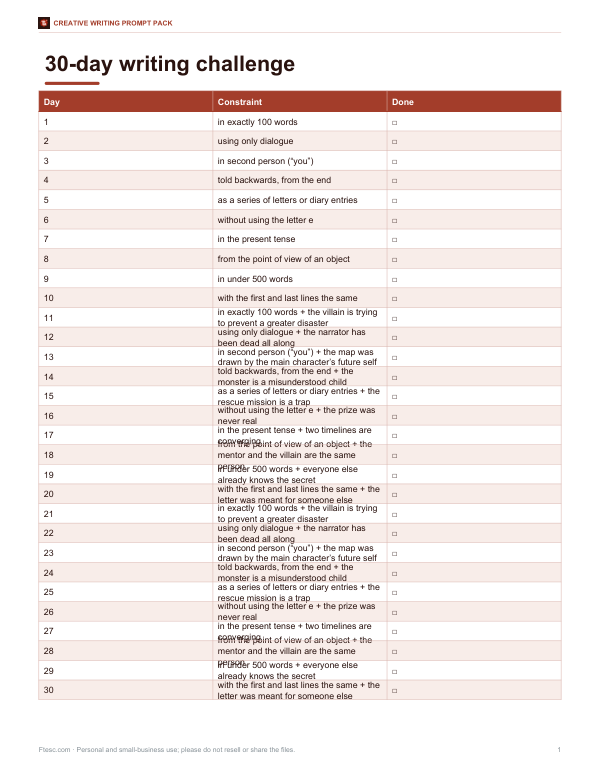
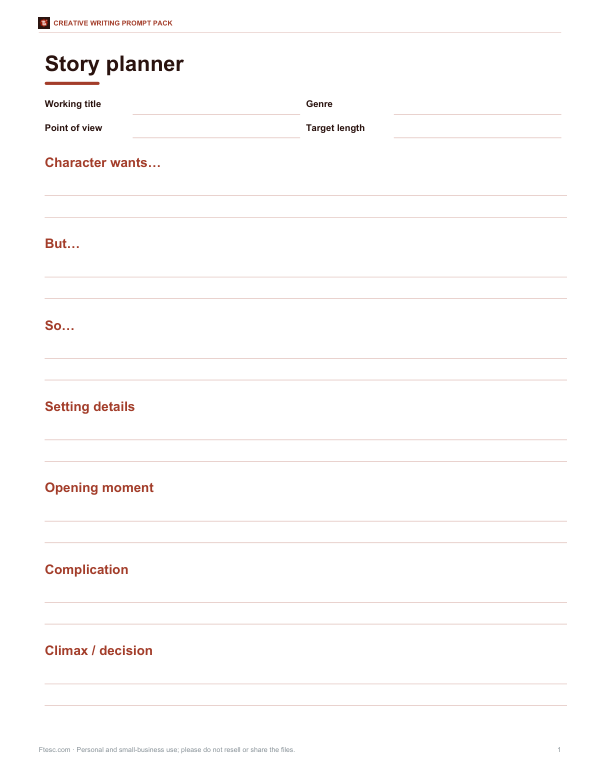
Printable 100 story prompts, 30-day writing challenge calendar, story planning worksheet, character profile template and an Excel writing log.
- 100 prompts (PDF/DOCX)
- 30-day challenge (PDF)
- Story planner (DOCX/PDF)
- Character profile (DOCX/PDF)
- Writing log (XLSX)
Formats: PDF, DOCX, XLSX. Instant download after payment (link valid 72 hours, up to 5 downloads). AI-assisted: the templates were drafted with AI help and reviewed and laid out before publishing.
$5.00 USD, one-time 5 files · about $1.00 each
- Instant download
- 7-day refund
- Secure checkout by Stripe
7-day money-back guarantee. Full refund within 7 days of purchase, even after you download.
Free sample: 100 Story Prompts (PDF, 111 KB)
Full refund within 7 days — see the refund policy and license.
Free printables
Single sheets you can print right now, no sign-up. The full pack adds every sheet in one download plus the editable files.
 Printable Character Profile Sheet
 Printable Writing Log Sheet
How the prompts are built
Each prompt combines a genre (15 options), a character with a built-in hook (20), a setting (16) and a conflict (12) — the problem that drives the plot. Add a twist to complicate the story or a constraint such as “in exactly 100 words” or “using only dialogue” to stretch your craft. That gives more than 57,600 core combinations before twists and constraints. Lock the parts you love and reroll the rest.
Why constraints help creativity
Unlimited choice is paralysing; limits force decisions. A prompt that fixes the character and conflict lets you spend your energy on voice, structure and detail. Formal constraints — second person, a single scene, 100 words — push you out of habits and often produce your most surprising writing. Many published stories began as exercises.
Turning a prompt into a story
- Ask what the character wants most and what stands in the way — the conflict gives you a start.
- Choose the moment where the story begins: as close to the conflict as possible.
- Decide what the character will lose if they fail.
- Sketch three beats: the problem, a complication, a decision.
- Write a messy first draft without editing.
- Revise for a clear change: by the end, the character or situation is different.
Prompt examples
| Genre | Prompt |
|---|---|
| Mystery | A retired detective who can’t stop noticing clues, in a small town during a blizzard, has 24 hours to find a missing child. |
| Fantasy | A dragon who is afraid of fire, in a floating market at dawn, must return something stolen long ago. Twist: the villain is trying to prevent a greater disaster. |
| Science fiction | An astronaut returning to an empty Earth, on a train that never stops, wakes up with someone else’s memories. |
| Literary | A musician who has lost their hearing, in a vineyard during harvest, must choose between two people they love — written in present tense. |
Using prompts in the classroom
- Warm up each lesson with a 10-minute sprint.
- Give the whole class the same prompt and compare approaches.
- Lock the setting and let each student reroll characters for a shared-world anthology.
- Use constraints to teach technique: dialogue-only for punctuation, second person for voice.
- Print ten prompts for a choice board.
Worked example
A writer generates: “Write a ghost story about a mapmaker drawing a country that doesn’t exist, in a lighthouse on a fog-bound island, who finds a door that wasn’t there yesterday. Twist: the map was drawn by the main character’s future self.” They lock the character and setting, reroll the conflict twice, keep the door, and start a 15-minute sprint. The first draft opens with the mapmaker finding their own handwriting on a map in the new room.
Revising your prompt story
- Let the draft rest for a day before revising.
- Check the opening: does the first paragraph show the character and the problem?
- Cut scenes that don’t move the conflict forward.
- Make the ending answer the question the beginning raised.
- Read dialogue aloud to hear whether it sounds natural.
- Trim filler words and sharpen verbs.
Short pieces written from prompts make excellent practice for submitting to flash fiction magazines and competitions, many of which have word limits between 500 and 1,500 words.
Prompts for writer’s block
When a longer project stalls, use a prompt sideways: take the conflict and ask how it would hit your current protagonist, or roll a twist and drop it into the next chapter. Even if the scene doesn’t survive the edit, writing it often reveals what the story needed. Switching genre for an afternoon — writing your fantasy characters into a comedy scene — can also loosen things up.
Writing challenges
Generate ten prompts and write one a day, or thirty for a month-long challenge. During novel-writing months, use prompts for warm-ups or to unstick a scene: roll a twist and ask how it might apply to your current chapter. Track word counts in the paid pack’s writing log.
Genres at a glance
| Genre | Readers expect |
|---|---|
| Mystery | A puzzle, clues and a satisfying solution |
| Romance | A central relationship and an emotionally satisfying ending |
| Horror | Dread, fear and something threatening |
| Fantasy | A world with magic or rules unlike ours |
| Science fiction | Ideas about science, technology or the future |
| Thriller | High stakes, danger and pace |
Knowing the expectations lets you meet them — or subvert them deliberately.
Privacy
Prompts are generated in your browser; nothing is stored.
Frequently asked questions
How do I use a story prompt?
Start writing from the situation it gives you; don’t worry about quality in the first draft.
Can I keep part of a prompt?
Yes, lock the genre, character, setting or conflict and reroll the rest.
Are the prompts suitable for students?
Yes, they are family-friendly; choose genres to suit the class.
What is a writing constraint?
A rule such as a word limit or point of view that shapes how you write.
Can I make a list of prompts?
Yes, press “Make 10 prompts”.
How long should a story from a prompt be?
Anything from 100-word micro fiction to a full short story; set a word count before you start.
Can I publish a story written from these prompts?
Yes, the prompts are starting points and the story you write is your own.
What is a writing sprint?
A short, timed burst of writing — often 10 to 30 minutes — without stopping to edit.
Is anything stored?
No, it runs in your browser.